The annual Secretariat for the Congress of the Leaders of World and Traditional Religions convened this week in Astana, Kazakhstan, for inter faith and intercultural dialogue. This year, their particular focus turned to shared concerns in relation to the impact of climate change and Artificial Intelligence (AI). A third topic addressed the rights of children with incurable diagnoses.
Held on October 7 at the Palace of Peace and Reconciliation, the meeting was attended by more than 30 leaders of world and traditional religions (including Anglicans), international organisations, government officials and other public figures from 20 countries.
Anglicans have been actively involved in these meetings since the Archbishop of Canterbury usually sends representatives to the Congress. In 2025, the Rt Revd Danald Jute, Bishop of Kuching and Chair of the Anglican Inter Faith Commission, attended. The Rt Revd Dr Jo Wells, Deputy Secretary General of the Anglican Communion and Bishop for Episcopal Ministry, has also served on the Congress Secretariat for the past 7 years, representing the Anglican Communion as well as the Archbishop of Canterbury.
This year, as part of their ongoing engagement in inter faith issues, the Secretariat chose to direct attention to two urgent global challenges: climate change and AI. The collaboration of such a wide range of religious leaders, representing all the major faith traditions across the world, has the potential for great impact where collaboration can be achieved.
As the meetings concluded, the Congress Secretariat agreed three declarations in relation to current societal challenges through the lens of faith-based values. They will be added to the Astana Peace Declaration, which was produced after the 2025 Congress to reflect the participants’ common position on overcoming the global crisis of trust, strengthening security and promoting interreligious harmony.
The declarations
‘The Ethical Code on the Use of Artificial Intelligence in the Field of Religion’ seeks to enshrine the primacy of human dignity, freedom of conscience, human responsibility and the preservation of spiritual autonomy in the use of new technologies.
‘The Role of Religions in Combating Climate Change’ establishes a shared value-based platform for environmental responsibility, care for nature and responsibility to future generations.
Finally, ‘The Charter of the Rights of the Incurable Child’, a joint initiative between Kazakhstan and the Holy See, focuses on protecting the dignity and rights of children with incurable illnesses. The Charter affirms the need for humane treatment and the necessary medical and psychological assistance, taking into account the needs of the child’s family and the child’s spiritual needs.
As a member of the Working Group which shapes the work of the Congress Secretariat, Bishop Jo Wells was among those faith leaders who sought to encourage the dialogue to move in the direction of addressing these agreed practical challenges together. She urged that the delicate conversations continue, but with an active attitude towards walking and working together in the direction of shared horizons for the sake of the needs of the world and its most vulnerable people.
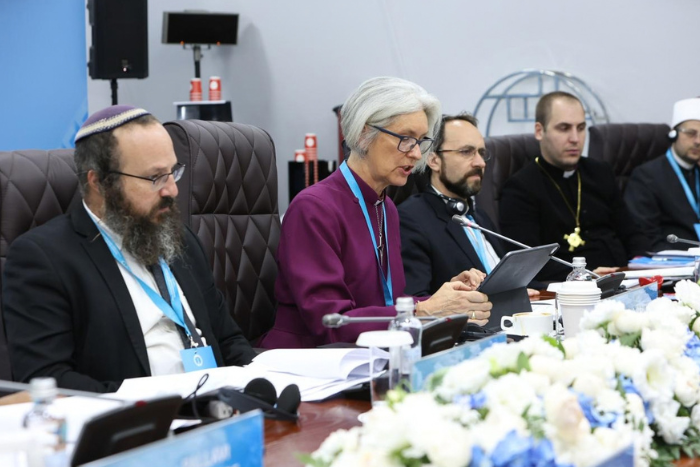
The Rt Revd Dr Jo Wells, Deputy Secretary General of the Anglican Communion and Bishop for Episcopal Ministry, speaks at the Secretariat meeting of the Congress of Leaders of World and Traditional Religions.
Bishop Jo told Anglican News: ‘The issues we are addressing cannot be resolved by the specialists or the technicians, whether in climate and the environment, in artificial and superhuman intelligence, or in medicine and palliative care. Nor can they be resolved by any single faith group, government or nation. They require a level of cooperation that transcends our differences and overrides our politics, because they each address us all. Only together can we make the difference that matters.’
About the Congress of the Leaders of the World and Traditional Religions
In 2003, the government of Kazakhstan proposed convening the Congress of the Leaders of World and Traditional Religions. Kazakhstan’s initiative to convene the Congress is rooted in centuries-old traditions of religious tolerance and hospitality, which form an integral part of the cultural identity of the Kazakh people.
Between 2003 and 2026, eight Congresses have taken place. These meetings are intended to be a platform for multilateral dialogue and cooperation, to promote spiritual and moral values as foundational to society and also to assist in upholding mutual respect among different religions, with a view to preventing the exploitation of religion to incite and escalate conflict. The Congress Secretariat also meets annually to ensure timely response to emerging world issues.
More information
Learn more about the 2026 meeting of the Secretariat Congress of the Leaders of World and Traditional Religions.
Learn more about the history of the Congress.
Read the Astana Peace Declaration from the 2025 Congress meeting.
Learn more about the ‘Charter of the Rights of the Incurable Child’.