The Province of the Anglican Church of the Congo has been increasing its efforts to respond to the alarming spread of Ebola and engage with calls made by the World Health Organisation for community organisations to lead the fight against the disease. Across six dioceses, the Church support healthcare services in implementing infection control measures and dispelling misinformation.
On 15 May 2026, the Democratic Republic of Congo (DRC) declared its 17th Ebola outbreak since the virus was first identified in 1976. Within 48 hours, the World Health Organisation had declared the situation a Public Health Emergency of International Concern (PHEIC), its highest level of alert, requiring urgent international coordination.
Combatting Ebola Fatigue at the global and local levels
The Rt Revd William Bahemuka Mugeny, Bishop of Boga diocese, has warned of ‘Ebola fatigue’ and echoed comments made by the UN Secretary-General, António Guterres, on August 4, who said that ‘indifference’ to the outbreak is a serious danger to effective containment.
Bishop William relayed, ‘The response was quick, compassionate, and strong at first. Now, it seems as if the word “Ebola” has all but vanished from the international conversation, and along with it, the thoughts and prayers for the people of Congo’.
‘The disappearance of this outbreak from the global conversation could leave some with a bad impression, thinking that the virus has been contained, effective means of treatment have been found or the spread has slowed. This, however, is not the case. For the people of Congo and other affected areas, the reality of this disease is a daily struggle’, he said.
The bishop has reported that Ebola is particularly prevalent in the province’s eastern region, which faces a severe humanitarian and health crisis marked by conflict, population displacement, insecurity, poverty and limited access to essential services. In Ituri, North Kivu, South Kivu, and Haut-Uélé, high population mobility, mining and commercial activities, and cross-border movements are contributing to the spread of infectious diseases.
In a context that has seen 16 previous outbreaks of the virus, Bishop William is also concerned that DRC is experiencing its own form of Ebola fatigue. ‘They are tired of fighting the disease’, he says, and ‘their frustration has boiled over into violence against healthcare workers.’
This reinforces the message shared by the UN Secretary-General on August 27, who lamented that ‘more than 40 healthcare workers have lost their lives while treatment centres and ambulances have been attacked’ since the start of the outbreak in May.
The Church advances community health responses
The Church in DRC is developing the next phase of its ongoing efforts to tackle the situation. Due to an extensive network of dioceses, parishes and religious leaders, churches are often strategic partners in advancing community health priorities.
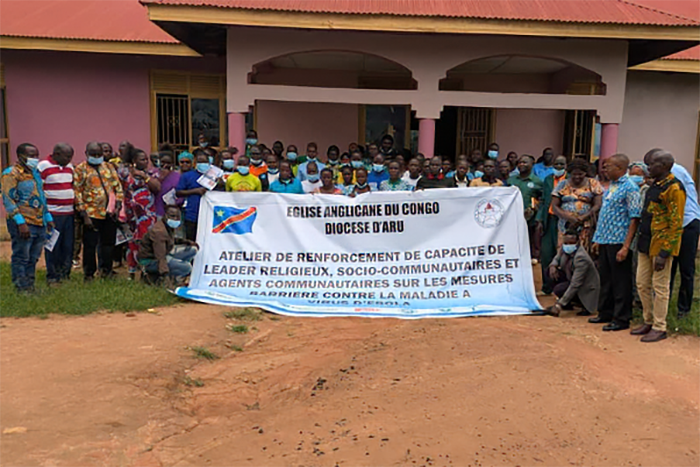
A capacity-building workshop held by the Diocese of Aru for religious and community leaders and workers to help them combat Ebola virus
Starting in September, and running for three months, six dioceses (Boga, Aru, Beni, Butembo, Kisangani and Kinshasa) will work to strengthen community knowledge on transmission and prevention, promote good hygiene practices in community buildings, and expand training to 300 more community and religious leaders and volunteers.
Bishop William is urging community leaders, healthcare workers and religious leaders to work together until the virus is eradicated, saying: ‘The Lord is calling His church to lead the way in this day as it has in the past - we can overcome the weariness to see victory on the other side. We remain committed to training health care workers and establishing better preventive provisions so that pastors, leaders and church members alike may learn new skills, teach new practices and, above all, live out the teaching of Scripture.’
Bishop William hopes the project will strengthen prevention efforts, reduce the transmission of Ebola, promote early care-seeking and support the efforts of health authorities in high-risk areas.
Several Anglican leaders in DRC have spoken up since the start of the latest outbreak to highlight the challenges they and the communities they serve are facing, including the Most Revd Georges Titre Ande, the Archbishop of the Province de l’Eglise Anglicane Du Congo.
The Anglican Health and Community Network has also been connecting and facilitating knowledge sharing between medical professionals around the Communion to support those in affected areas.
Speaking about the importance of preventing the spread of Ebola and the dangers of inaction and apathy, Malachi St Jean, Advocacy and UN Team Assistant at the Anglican Communion Office and member of the Anglican Health and Community Network, said: 'Containing the 17th Ebola outbreak and preventing the next requires listening to affected communities, strengthening frontline actors, connecting local action to national and global responses, and ensuring sustained commitment over time'.
More information
Learn more about the response from the Anglican Communion to the 17th Ebola outbreak.
See an Anglican News article from June 1, featuring the perspectives of some of the church leaders in DRC on the Ebola outbreak and the Church’s role in responding to it.
See a recent article from the UN calling for community groups to lead the fight against Ebola and indifference.
See the statement on August 27 from the UN Secretary-General about the danger of indifference to Ebola.
Learn more about the Anglican Health and Community Network.