Ras Morbat Eye Clinic operates in Aden, Yemen, within the Diocese of Cyprus and the Gulf. Known locally as ‘the Church Clinic’, the facility aims to provide affordable and accessible eye care to the people of Aden and surrounding areas despite significant challenges.
The clinic was first established in 1996 as a charitable clinic attached to Christ Church, Arden, and eye care services were later introduced. The clinic website states that, ‘from the very beginning, the partnership between the Anglican Diocese of Cyprus and the Gulf and the Ministry of Health in Aden has been a good example of compassion and care for people in need without regard to religious or tribal identities.’ The diocese is part of the Episcopal Church in Jerusalem & the Middle East and supports the clinic in cooperation with the Ministry of Health.
Mansour Yousuf, the Clinic Administrator and Director, explains that the facility receives ‘patients from Aden as well as from other parts of Yemen. Our services include eye examinations, diagnosis and treatment of eye diseases, medicines, glasses, cataract treatment and surgery and other necessary ophthalmic procedures.
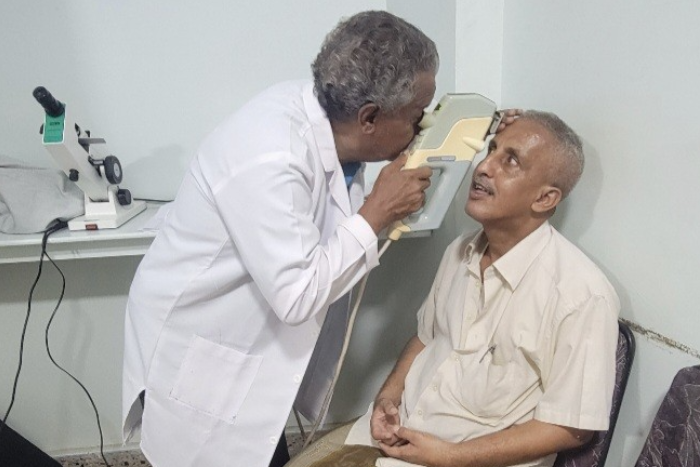
A patient receiving an eye examination at Ras Morbat Eye Clinic.
‘Our priority is to make good-quality eye care available to people who may otherwise be unable to afford treatment. We particularly serve poor and vulnerable families, elderly people, internally displaced persons and refugees… Restoring sight is about much more than treating an eye condition. For many patients, improved vision means regaining independence, dignity, the ability to work and the opportunity to participate more fully in family and community life.’
Eye care in a place of escalating conflict
Currently, the day-to-day operations of the Ras Morbat Eye Clinic are under increasing pressure due to escalating conflict in Yemen.
Yemen is one of the poorest countries in the world and has experienced periods of conflict since 2015, stretching the public health sector beyond capacity for basic healthcare.
The United Nations recently highlighted that ongoing fighting between the Saudi-backed authorities and Iran-backed Houthi militia has escalated, displacing 80,000 in Yemen, some for the second or third time. Sources say that in recent weeks, the Houthi militia group has seized control of strategic ports in the Red Sea with a view to attacking vessels from Saudi Arabia, which now relies on the route to transport fuel since the conflict between Iran, the US and Israel has made transporting through the Strait of Hormuz difficult.
The recent conflicts have not yet reached the clinic directly; however, the facility has faced significant challenges maintaining essential systems like water and power, which affects its capacity to treat patients, maintain hygiene practices and power essential equipment.
There are also frequent nearby explosions and growing anxiety over food and medicine insecurity to contend with. Because of recent changes to the control of transportation routes, reports suggest that even routine medications have become cost-prohibitive to import. The clinic staff also try to visit the refugee camps around Aden, but due to the unrest, this is challenging. The UNHCR (the UN refugee agency) regularly brings people from the camps for check-ups and treatment. The clinic has no security gate, testifying to the trust built with the surrounding community despite its situation within a context of frequent conflict.
Speaking about the difficulty in maintaining power to the clinic, Mansour shared that since the beginning of the war, ‘one of the clinic's greatest challenges has been the severe and continuing shortage of public electricity. At times, electricity has been unavailable for many hours, with only short periods of public supply. This forced us to depend heavily on our old diesel generator in order to keep the clinic functioning. The cost of diesel, generator maintenance and public electricity placed a considerable financial burden on the clinic’.
Supporting the Ras Morbat Eye Clinic
During such challenges, the clinic is actively seeking support for its vital healthcare work. The Rt Revd Sean Semple, Bishop of Cyprus and the Gulf, recently shared publicly about the importance of the heritage of service the clinic represents. ‘Since 1996, our Diocese has provided compassionate care for the people of war-torn Yemen through the work of Ras Morbat,’ said Bishop Sean, ‘helping those in need of specialist healthcare in one of the poorest countries in the world.’
In August, thanks to help from the Diocese of Cyprus and the Gulf and the US-based ‘United Thank Offering’, a solar-powered system was made possible. Mansour shared that the clinic was ‘extremely grateful’ for the provision of solar energy. ‘The solar system has made a major difference to the clinic by providing a much more reliable and sustainable source of electricity. It enables us to operate medical equipment and air-conditioning and to continue caring for our patients with far less dependence on the diesel generator… [This] directly supports the continuity and quality of healthcare that we are able to provide to the community.’
With generous support, the clinic now also has secure access to water and appropriate sanitation facilities. Mansour shared that the clinic now has ‘separate toilet facilities for women and men, and water is available throughout the week… We have water storage tanks installed on the roofs of the clinic buildings. These tanks allow us to store sufficient water and maintain a continuous supply for the clinic.
‘The solar energy system has also contributed positively to our water arrangements by providing reliable electricity to support the clinic's water system. This has strengthened our ability to maintain water availability, hygiene and sanitation even during interruptions to the public electricity supply.’
As conflict escalates in the region, ongoing assistance for this important area of health provision is vital.
More information
Learn more about Ras Morbat Eye Clinic.
See a recent comment by Bishop Sean about the clinic and a statement from the diocese about the solar program.
Find out more about the recent conflict in Yemen according to the UN.
Learn more about the United Thank Offering.