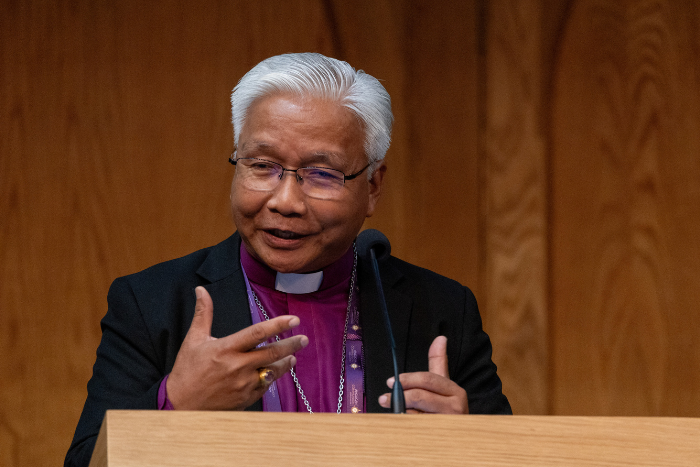
Photo Credit: Neil Turner / ACC-19
On July 3, at the nineteenth meeting of the Anglican Consultative Council (ACC-19), delegates of the ACC heard from the Anglican Inter Faith Commission (AIFC) about how the Commission serves the Communion through building relationships across faiths and engaging in education and advocacy.
The Chair of the AIFC, the Rt Revd Danald Jute, Bishop of Kuching (the Church of the Province of South East Asia), addressed members of the ACC, speaking about the history of the Commission, as well as its recent work. Acknowledging and celebrating the existing foundation of inter faith work, Bishop Danald said, ‘There is already a rich tapestry of engagement throughout the Anglican Communion… Our role as AIFC is not to reinvent the wheel but to lift up and to support existing works and to encourage and resource where necessary.’
The Anglican Inter Faith Commission functions as the Anglican Communion’s primary instrument for high-level religious diplomacy and grassroots inter-religious support. Operating at the intersection of diverse cultures and political systems, the Commission provides theological resources for peaceful co-existence in pluralistic societies and offers advocacy for Anglican communities facing persecution.
According to Bishop Danald, the work of the commission is deeply rooted in the third and fourth Anglican Marks of Mission ‘to tend, to respond to human need by loving service and to transform unjust structures of society…and to pursue peace and reconciliation’. These efforts could be strengthened through working well with other faiths for the benefit of developing a more just society.
Danald reflected on the gathering of the AIFC in Kuching, Malaysia, in 2025 and on the value of learning from Kuching: a society which is predominantly Muslim but recognised for its ‘harmonious, multifaith, social fabric’ despite differences of faith. Bishop Danald recounted that during that meeting in Kuching, the Commission took the opportunity to discuss what has shifted in the ‘global scene’ and ‘religious landscape' in recent years.
The commission noted that much had changed since the publication of Generous Love in 2008, a work of foundational Anglican theology of inter faith relations which provides a framework for engaging with other faiths while remaining faithful to the Gospel. Bishop Danald observed that since 2008 there have been new or worsening geopolitical fractures and localised conflicts as well as a rise of nationalism, including ethno-religious nationalism, but ‘it is possible to overcome whatever those tensions might be.’ He urged ‘there needs to be a move “beyond table talk” to united action no matter our differences… Today demands from us active religious diplomacy’.
Reflecting on challenges and opportunities for stronger inter faith relationships across the Communion
Canon Dr Andrew Smith, Secretary of AIFC and Director of Inter Faith Relations for the Bishop of Birmingham, shared in the session that the commission had identified five areas in which significant change has occurred since the release of Generous Love, which should now be ongoing topics for dialogue and work for the Inter Faith Commission. The AIFC intends to support Anglicans in reflecting how the following factors could impact on inter faith dialogues and relationships:
- Engaging with indigenous and emerging beliefs and practices
- Enhanced roles for women in church and in inter faith activity
- The effects of social media and AI
- The urgency of the ecological crisis and climate emergency
- The reality of Christian restriction and persecution
Seeking to initiate dialogue on some of these subjects, ACC delegates were invited to discuss challenges in their own contexts about how to engage indigenous and new belief structures as well as about the impact of having women in church leadership roles on existing inter faith relationships when the majority of faith leadership is still male. Delegates shared that patience and a willingness to continue talking without an agenda should be considered cornerstones of inter faith conversations.
The role of technology as a tool for connecting people across great distances and culturally different settings was also reflected upon. It was noted on a positive front that sharing of experiences and stories across contexts could deepen inter faith dialogues but also presented concerns that social media platforms can negatively impact mental health, disrupt healthy relationships, especially in young people, and transmit unhelpful stereotypes, all of which could potentially damage cross-religious connections.
In closing, Bishop Danald assured the ACC members that the AIFC is here to serve Member Churches in times of both opportunity and challenges regarding inter faith relations, encouraging churches to reach out for advice, support or input to the commission via the Anglican Communion Office. Bishop Danald then closed in prayer, thanking God for the diversity of humankind, asking for the grace to be good listeners and guidance when sharing 'our faith', to do so with humility, gentleness and authentic love for the neighbours in our communities.
More information
Learn more about the Anglican Inter Faith Commission.
Download the Generous Love resource which explores an Anglican theology of interfaith relations.
Read more about the meeting of the Anglican Inter Faith Commission in Kuching last year.