Photo Credit: Neil Turner
Members of the nineteenth meeting of the Anglican Consultative Council (ACC-19) heard encouraging news about the growing work of the Commission for Theological Education in the Anglican Communion (CTEAC) during its session on Friday, July 3.
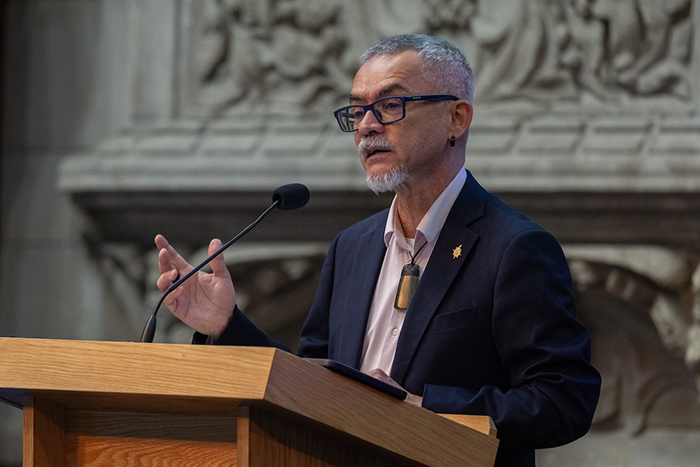
The report was presented by Dr Paulo Ueti, Adviser to CTEAC and the Inter-Anglican Standing Commission on Unity, Faith and Order (IASCUFO) and Theological Advisor for the Anglican Alliance.
The presentation began with greetings from the Rt Revd Dr Victor Atta-Baffoe, Bishop of Cape Coast in the Church of the Province of West Africa and Chair of CTEAC, who joined the meeting by video link from Ghana. Bishop Victor thanked ACC members for their support and shared his vision of an Anglican Communion in which all Christians, lay and ordained, continue to grow as lifelong learners and disciples of Christ.
Building on that vision, Dr Ueti spoke about the Commission's commitment to shared learning across the Communion. ‘CTEAC envisages an Anglican Communion in which everyone, lay and ordained, is a lifelong learner in discipleship and the mission of God,’ he said.
‘We are seeking methods of theological education that are diverse and non-hierarchical, honouring the many voices and traditions of a global Church, rather than assuming knowledge flows in only one direction.’
He explained that the Commission's work is shaped by four guiding principles: lifelong discipleship, making theological education accessible to everyone, learning from one another across the Communion, and valuing the wisdom and experience of churches in every context.
Rather than adopting a single global model, CTEAC has developed a programme of regional consultations that respond to the needs and priorities of different parts of the Anglican Communion. Since its formation, consultations have taken place across Asia, Africa, Oceania and the Americas, bringing together theologians, bishops, clergy and lay people to share ideas and strengthen theological education within their own regions.
Reflecting on the consultation held in Limuru, Kenya, Dr Ueti said: ‘Gatherings like Limuru are where our vision becomes reality. They bring people together to teach, to learn, and to build relationships that continue long after the consultation has ended.’
Delegates also heard about From Slavery to Freedom, a study guide developed by the Commission following ACC-18 in Ghana. Inspired by delegates' visit to the slave castles at Cape Coast, the resource encourages churches to reflect on the legacy of slavery, racism and colonialism through biblical, historical and theological study.
Turning from the Commission's work to its future, Dr Ueti invited delegates to reflect together on the future of theological education across the Communion. Around their tables, members discussed what is working well in theological education within their own provinces, the challenges they face and the ways in which CTEAC might support them. Conversations also explored how Indigenous voices, younger generations and the Anglican Communion's Five Marks of Mission can help shape theological education for the future, while considering how theological education can continue the work of decolonisation across the global Church.
In concluding his presentation, Dr Ueti welcomed the proposed Vision 36 initiative, describing it as an opportunity to strengthen discipleship alongside the ambitious goal of planting or revitalising one million churches across the Anglican Communion over the coming decade.
The presentation reflected the Commission's commitment to theological education that is rooted in local contexts while strengthening the relationships that bind the Anglican Communion together.
More information
Click for more information on the Commission for Theological Education in the Anglican Communion.
Learn more about Vision36 - a ten-year church planting and revitalisation initiative.