From the International Anglican Family Network
When Fr Julião Mutemba discovered that most of the children living on Maputo’s municipal rubbish dump had no birth certificate and therefore no legal existence in the eyes of the State, he decided to do something about it.

Fr Julaio Mutemba with his family
Until his untimely death in May this year, Fr Mutemba worked tirelessly for the people at the 17 hectare Hulène rubbish dump near Maputo’s international airport in Mozambique. He well understood the significance of a birth certificate for children and families living and working there: “When children under school age came to us for baptism, we discovered that most of them had not been registered,” he said.
“People grow from children to adults living out of the dump; boys and girls have the dump as their meeting place. [It’s] where they work, play and fall in love. That results in children being born of unregistered parents.
“Living without birth registration means that, even if children can begin the first school grades, they will stop somewhere because they cannot take examinations without the documents. They cannot gain access to work, to basic services such as electricity, water, SIM card registration. It is as if people are denied any aspect of development.”
For Fr Mutemba it was as if the children were strangers in their own land, so his church started including education about birth registration in its outreach work among families. Parents are made aware how important it is to take this step towards a safer and more hopeful future for their children.
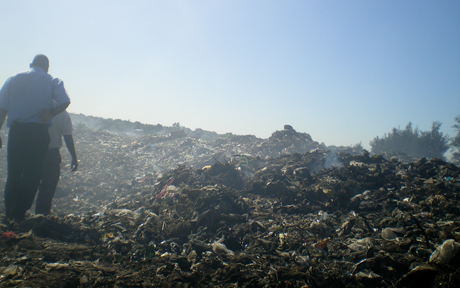 An estimated 700 people live on the dump, which has piles of waste reaching up to 15 metres high. People sort through the rubbish looking for things they can sell. Whole families search for recyclable materials. Others forage for food thrown into the refuse. When a rubbish truck arrives, people chase after it and jump on the back so that they can be the first to see the contents.
Fr Mutemba wrote on his parish website, “My interest in social development is urban transformation, addressing the challenges of the urban poor [and] by doing so joining to those who are ‘seeking the welfare of the city’ (Jeremiah 29.7). [In] the city where I am living, there are challenges of homelessness, street children, people living on the dump, human trafficking, child abuse, unemployment, and the church needs to participate as God’s agent for transformation.”
Urban areas are not the only places where a lack of birth registration can prevent children’s access to education, health care and the benefits and protection of citizenship. In rural villages in the Diocese of Muyinga, Burundi, local members of the Mothers’ Union realised that many parents were not registering the birth of their children.
Mmes Consolate, Joséphine and Zelda described the situation, “Burundian law requires all children to be registered within 15 days of birth but the importance of registering the birth of their children hasn’t yet sunk into the minds of all people, especially in rural areas.
“Some of the women would tell us that their children were not registered. Because of this, we have done a lot to sensitise our members in the Mothers’ Union about birth registration so that they can set a good example in the community. All our members are now educated to register children at birth and to encourage others to do so. We find that this work has a positive impact in the community.
“In our advocacy work, our daily activities are often tinged with sadness. For example, we had a case recently where a child had just lost his parents in a drowning accident in the River Ruvubu. We sent a letter to the SOS children’s village [in our region] to ask them to take him into their care. We had many problems because the child hadn’t been registered at birth.”
The latest Newsletter of the International Anglican Family Network (IAFN) highlights work being undertaken by churches around the Communion, often partnering with other agencies, to assist families in overcoming the obstacles to birth registration. IAFN Coordinator Dr Sally Thompson points out the scale of under-registration and that unregistered children are almost always in poor, marginalised or displaced families, or are from countries where systems of registration are not in place or functioning.
“Anglicans are committed to human flourishing and to transforming structures in society which thwart human potential and well-being,” she writes.
Dr Thompson also emphasises the many success stories, “Indigenous people being helped by the Church and Church leaders to obtain registration and their rights as citizens in Northern Argentina; partnerships with UNICEF and the Mothers’ Union are achieving great success in the number of children being registered in Uganda, Mozambique, Madagascar and the Democratic Republic of Congo; and projects to help empower women, ensuring they are registered and so are able to participate as full citizens in Egypt.”
The IAFN newsletter ‘Birth Registration: Church Responses’ is online here http://iafn.anglicancommunion.org/newsletters/2013/june/index.cfm
Notes
- For more information about IAFN and its promotion of birth registration, contact Dr Sally Thompson, [email protected] or the Revd Terrie Robinson, [email protected].
- To contribute stories about churches and birth registration in your area, please go to www.registerbirths.blogspot.com and click on ‘Comments’ at the end of one of the postings.